

For decades, video games have offered a simple exchange: time and money for fun and escape. But what if that equation was flipped? What if the hours you spent grinding for a legendary weapon could actually level up your real-life bank account? This is the revolutionary, and often controversial, promise at the heart of blockchain gaming. From the explosive hype of “play-to-earn” to the cautious optimism of a new “play-and-earn” model, the journey to merge real-world value with virtual worlds has been a wild ride filled with monumental successes, painful crashes, and a fundamental question: can a game be both genuinely fun and financially rewarding?
The Genesis of a Revolution
The idea of deriving tangible value from digital play didn’t emerge from a vacuum. The concept exploded into the mainstream in 2017 with a seemingly simple game: Crypto Kitties. This experiment in breeding and trading unique digital cats proved that people were willing to spend real money—in one case, over a hundred thousand dollars—on verifiably unique digital assets. It was a proof of concept for non-fungible tokens (NFTs) in gaming.
A year later, Axie Infinity arrived and began building the model we now recognize as play-to-earn (P2E). By 2021, it had become a global phenomenon, particularly in countries like the Philippines where players were reportedly earning a living wage by battling, breeding, and trading Axie creatures. It was a powerful demonstration of the model’s potential for economic impact. However, 2022 delivered a harsh reality check. A major hack coupled with a broader cryptocurrency market crash exposed the profound risks and volatility inherent in this nascent space, leading many to question its sustainability, as explored in our analysis, The Rise and Fall of Crypto Gaming: A Post-Mortem and a Path Forward.
Deconstructing the Play-to-Earn Model
So, what exactly is this model that sparked such fervor and subsequent fallout? At its core, a play-to-earn game is built on blockchain technology. This isn’t just tech jargon; it’s the foundational secret sauce. Because the game operates on a decentralized ledger, it can issue rewards—like cryptocurrency tokens or NFTs—that have real, tangible value and, crucially, are truly owned by the player.
This ownership is the fundamental shift. In a traditional game, you might purchase a skin or a weapon, but you’re essentially renting it. The developer retains control, and the item exists solely on their servers. In a P2E game, that digital sword is an NFT that resides in your personal crypto wallet. Because it’s your verifiable property, you can sell it on an open marketplace—an act that would get you banned in most conventional games.
How Players Actually Earn
Turning gameplay into cash requires some setup and understanding of the mechanics. Here’s a breakdown:
-
Get Set Up: First, you need a non-custodial crypto wallet (like MetaMask). Think of it as your digital backpack for game assets. You’ll often need to purchase some cryptocurrency to start, perhaps to buy your initial characters or an entry ticket. Then, you connect this wallet to the game. Most importantly, thorough research into the game’s economy, community, and tokenomics is essential before investing any time or money.
-
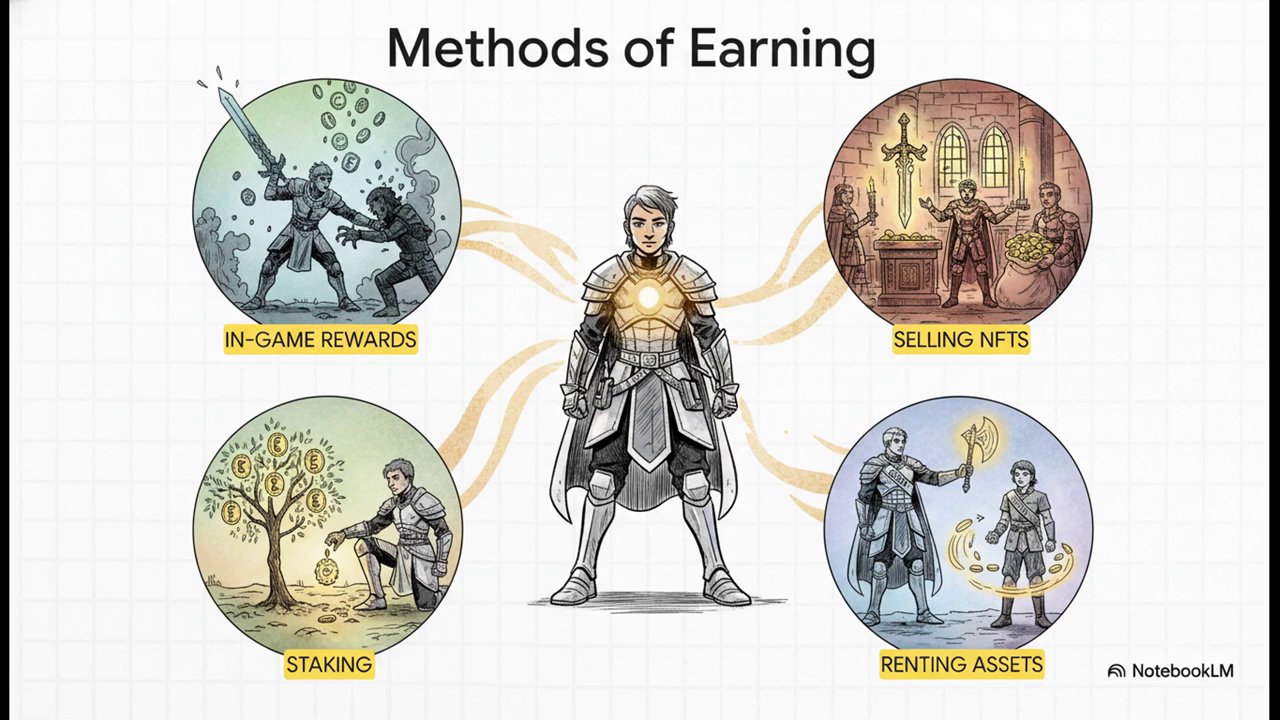
The Earning Mechanics: Once you’re in, there are several pathways to generate value:
- Playing the Game: The most straightforward method. Winning battles, completing quests, and achieving milestones often reward you with the game’s native crypto tokens.
- Trading Assets: Crafting or finding rare items (NFTs) and selling them to other players on a marketplace.
- Staking: Some games allow you to “stake” your tokens or assets, similar to earning interest, by locking them up to support the network.
- Scholarships: A unique model where you can rent out your powerful characters or assets to other players and take a percentage of their earnings.
The Critical Role of Wallets
Wallets are so pivotal they deserve a closer look. A common misconception is that a wallet “stores” your crypto. It doesn’t. Your assets live on the blockchain. The wallet holds your keys: a public key (your address for receiving assets) and a private key (the password to access and send your assets). Lose your private key, and your assets are gone forever.
For P2E gaming, a non-custodial wallet, where you alone control the keys, is almost always required. This embodies the mantra of “being your own bank”—offering total control but also total responsibility.
The Backlash and Inherent Challenges
Earning money while playing sounds like a dream, but the reality quickly grew complicated. The P2E model faced a storm of criticism and deep-seated problems. As one analysis pointed out, the focus for many games became solely the earn part, while the play part was neglected. The result was games that felt like tedious jobs rather than sources of entertainment.
The criticism grew sharper. Respected voices in gaming journalism pointed out that many P2E economies resembled pyramid schemes, reliant on a constant influx of new players buying in to pay out earlier adopters. When new player growth stalled, the economies collapsed, a cycle detailed in The Inevitable Crash: Why Crypto Gaming Keeps Failing and What It Means for Players.
Beyond economics, a massive technical hurdle emerged: speed. Modern games demand instant feedback, but blockchains are inherently slower, requiring time to confirm transactions. To bridge this gap, developers must create complex layered systems—letting players interact in a fast, off-chain environment while slowly recording the outcomes to the blockchain. It’s an engineering challenge that highlights the friction between seamless gameplay and decentralized verification.
The traditional gaming industry reacted strongly. Valve banned all blockchain games from Steam. Ubisoft’s NFT initiative flopped spectacularly. Surveys showed a majority of game developers were skeptical. Most tellingly, players themselves protested so vehemently that major studios canceled their Web3 plans.
A New Hope: The Rise of Play-and-Earn
With such significant backlash, is the dream of blockchain gaming dead? Not necessarily. A new model is emerging from the ashes of P2E’s boom-and-bust cycle: play-and-earn.
This isn’t just a semantic change; it’s a philosophical revolution. The core idea is simple: make a fun game first. Create an experience people want to play even if there were no financial rewards. The ability to earn and own assets becomes a secondary perk, a bonus layer on top of a solid gameplay foundation—not the sole reason for the game’s existence.
This shift aims to build a sustainable system. In the old P2E model, the focus was profit, the motivation was money, and the foundation was often shaky. Play-and-earn flips the script: the focus is fun, the motivation is enjoyment, and the goal is to build a compelling game that retains players for years, thereby creating a more stable and organic economy. This approach is evident in newer projects that prioritize engaging gameplay loops, as seen in some of the titles featured in our guide to The Top 5 Freshest Play-to-Earn Games You Need on Your Watchlist.
Conclusion: Fun First, Finance Second?
The evolution from play-to-earn to play-and-earn represents a critical maturation for blockchain gaming. The initial gold rush exposed the pitfalls of prioritizing economics over engagement. The million-dollar question remains: Can developers truly put the game first while integrating true digital ownership? Can they resist the temptation to let monetization strategies overshadow core gameplay?
The future of this fusion likely hinges on this balance. The promise of owning your in-game achievements and assets is powerful and aligns with a growing desire for digital property rights. However, for blockchain gaming to move beyond a niche and achieve mainstream adoption, it must deliver on the primary promise of gaming itself: fun, immersion, and escape. The “earn” potential may attract players initially, but only a great “play” experience will keep them. The journey continues, and the next level is all about sustainability.