
For anyone new to the world of blockchain and crypto, the concept of “play-to-earn” gaming can sound too good to be true. How can you possibly play a video game and get real money out of it? Is it a scam, or can it be a sustainable model for the future of entertainment? This guide breaks down the fundamentals, explaining how play-to-earn works, how it differs from traditional gaming, and why it represents a revolutionary shift in digital ownership and virtual economies.
- The $10 Billion Question: What’s Wrong with Traditional Gaming?
- The Core Innovation: Real Ownership in Virtual Worlds
- The Simple Economics: A Transfer of Wealth
- A New Business Model: How Game Companies Profit
- The Technology That Makes It Possible: Blockchain & NFTs
- The Real-World Impact: Opportunity and the Future
- Conclusion: A Paradigm Shift in Digital Interaction
The $10 Billion Question: What’s Wrong with Traditional Gaming?
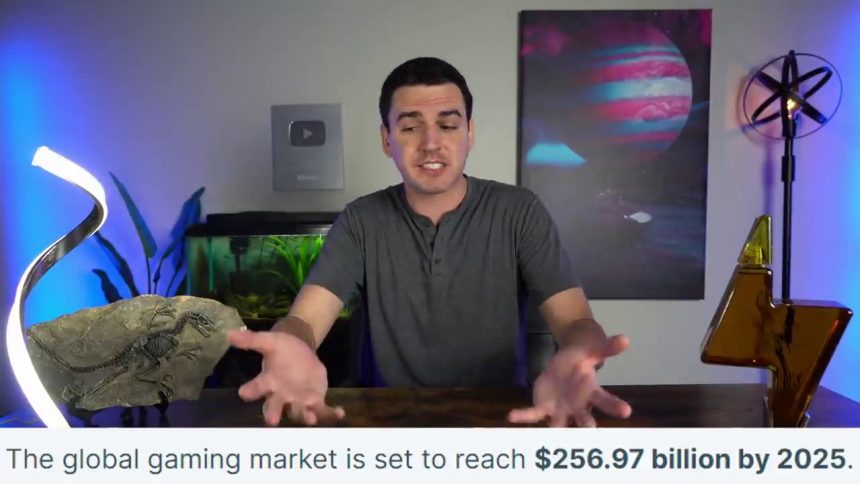
Before we can understand the new, we must look at the old. The video game industry in the United States alone generates over ten billion dollars a year. This revenue comes from selling games that, in the end, give players nothing except for fun. Consider a free-to-play title like League of Legends. A player might spend over a thousand dollars on cosmetic skins. What do they get in return? Enjoyment, a sense of coolness in a match—and that’s about it.
If that player ever wanted to sell those digital skins to someone else, they can’t. It’s against the terms of service. The player doesn’t actually own the assets; the gaming company does. The company could terminate the account at any time. This model is standard across virtually all games today. Play-to-earn gaming aims to change one core, fundamental aspect of this relationship, which then unlocks the potential for players to earn real value for their time.
The Core Innovation: Real Ownership in Virtual Worlds
That one fundamental change is real ownership. In a play-to-earn ecosystem, if you earn or purchase an item—a sword, a piece of land, a unique avatar—you truly own it. This means you can take that item out of the game’s direct ecosystem and sell it to another player on an independent, open marketplace. You have verifiable, transferable ownership of a digital asset, much like owning a physical trading card or a piece of art.
This simple shift from licensed access to true ownership is the bedrock of the play-to-earn revolution. It transforms digital items from fleeting privileges into tangible assets that hold and can accrue value based on a free market.
The Simple Economics: A Transfer of Wealth
So, where does the money actually come from? The answer lies in the existing behavior of gamers. Billions of dollars are already spent in games purely for fun and status. Play-to-earn can be thought of as a transfer of wealth from the rich to the dedicated.
Here’s a classic example:
1. A dedicated player with more time than money invests hours into a game, gathering resources and crafting a powerful, rare sword that exists as a unique NFT.
2. A wealthy player desires that powerful sword but lacks the time to grind for it. Their time is better spent earning money at their job.
3. The wealthy player can then purchase the NFT sword directly from the dedicated player on an open marketplace.
The dedicated player has “played to earn” by creating value (the powerful sword) that someone else is willing to pay for. This mirrors the real-world economy: if you provide value that others find valuable and are willing to pay for, you can make money. At its most basic level, play-to-earn games are simply new worlds where a free digital economy can exist. For a look at games already building robust economies on major blockchains, check out our guide to the Top 5 Play-to-Earn Games Building on Ethereum Right Now.
A New Business Model: How Game Companies Profit
A natural question arises: if players are selling to each other, how do the game development companies make money? Traditionally, companies profit by being the sole seller to players and often restrict player-to-player trading to protect that revenue stream.
Play-to-earn turns this model upside down. Through the power of blockchain and smart contracts attached to NFTs, developers have a new revenue source: transaction taxes. Returning to our example, when the dedicated player sells the $1,000 sword to the wealthy player, the gaming company can program a small tax (e.g., 3-5%) into the NFT’s smart contract. This fee is automatically collected during the sale.
This creates a sustainable model akin to a country with a sales tax. A free economy operates between citizens (players), and a portion of the economic activity is siphoned to the governing body (developers) for continued maintenance, updates, and development. This aligns the incentives of the players and the developers toward building a thriving, long-term ecosystem.
The Technology That Makes It Possible: Blockchain & NFTs
None of this would be feasible without recent technological advancements. The core enablers are blockchain and Non-Fungible Tokens (NFTs).
Blockchain acts as a secure, public, and transparent ledger. It allows for provable ownership and tracks the movement of assets with trustless verification. This technology gave rise to cryptocurrencies like Bitcoin and Ethereum. When a game uses a cryptocurrency as its in-game currency, players can earn it and then trade it for other cryptocurrencies or flat money on decentralized exchanges—something strictly forbidden in traditional games.
NFTs (Non-Fungible Tokens) take this further by representing unique digital items. “Non-fungible” means it cannot be duplicated; each token is distinct. Unlike Bitcoin, where one is identical to another, an NFT can be a one-of-a-kind digital sword, a unique plot of land, or a rare avatar. This scarcity and verifiable ownership create the conditions for real value. If a game has a million players but only 1,000 of a certain powerful NFT item, basic economics dictate that those items will hold significant value.
The Real-World Impact: Opportunity and the Future
The implications extend beyond gaming as a hobby. We are already seeing novel economies emerge. For instance, players in wealthier nations might purchase NFT assets (like a powerful character or tool) but not have the time to use them. They can then lend or rent these assets to players in regions with fewer local economic opportunities. For the borrower, earning $5-$10 a day playing a game can represent significant wealth generation.
This points to a broader future. As automation and AI potentially displace certain job sectors, virtual worlds can become new frontiers for work and entrepreneurship. Play-to-earn isn’t just about gaming; it’s about creating digital economies where time, skill, and dedication can be monetized in novel ways. This model is being explored across various platforms, including emerging blockchain networks like Base, as seen in our roundup of the Top 5 Play-to-Earn Games on Base You Need to Try This November.
Conclusion: A Paradigm Shift in Digital Interaction
Play-to-earn gaming fundamentally changes the relationship between players, developers, and digital assets. By granting real ownership through blockchain technology, it transforms games from closed ecosystems into open marketplaces. The economic model shifts from companies extracting value from players to players and companies co-creating value within a shared economy.
It is a transfer of wealth based on dedication and value creation, enabled by verifiable digital scarcity. While the space is still maturing and requires due diligence to find legitimate projects, the core concept is sound and revolutionary. It’s not merely a new way to play; it’s a glimpse into a future where our digital and economic lives are increasingly intertwined, offering new forms of creativity, community, and financial opportunity. The journey is just beginning, and for those willing to learn and explore, the virtual frontier is open. For a critical perspective on the challenges the industry has faced while evolving, you can read about Six Years and Billions Later: The Disappointing Reality of Crypto Gaming in 2025.